Lavinia Maciver
Good Morning, Midnight (Reginald Hill Edition)Lavinia Maciver is the sister of Palinurus Maciver Senior and the aunt of his children, but she is more than a family connection: her home offers Cressida Maciver refuge from Kay Kafka, and her friendship with Laurence Waverley becomes an unwitting strand in the concealment of a death at Moscow House. Her eccentric devotion to birds shapes how others see her; the novel also shows the practical care and quiet constancy that lie behind that reputation.
Family and Early Role
Lavinia is the only sister of Palinurus Maciver Senior. After his first wife died, she moved into the family home for a time, helping with the household while the children were growing up. Cressida’s recollection of that period is affectionate in hindsight but sharply uncomfortable in its details: Lavinia would interrupt a visit with school friends to take them into the garden in search of a bird, sometimes keeping them waiting outside in freezing, wet weather. The girls at school turned her enthusiasm into a joke at Cressida’s expense. Lavinia’s eccentricity was thus an early source of embarrassment for her niece, even as her presence offered family support.
After Palinurus Maciver Senior died, Cressida was seventeen and still officially required to have a responsible adult. She refused to remain in Kay Kafka’s care and chose instead to sign up with Lavinia, whom she regarded as an acceptable blood relative despite describing her as dotty. Palinurus Maciver Junior was already an adult, while Helen Dunn, only nine, was deeply attached to Kay Kafka and resisted being separated from her. Cressida and her brother had tried to remove Helen from that influence, but Lavinia’s guardianship gave Cressida a separate way to reject Kay’s authority. The contrast is telling: Lavinia could be embarrassing and unconventional, but she was also a real alternative when Cressida needed one.
A Life Organized Around Birds
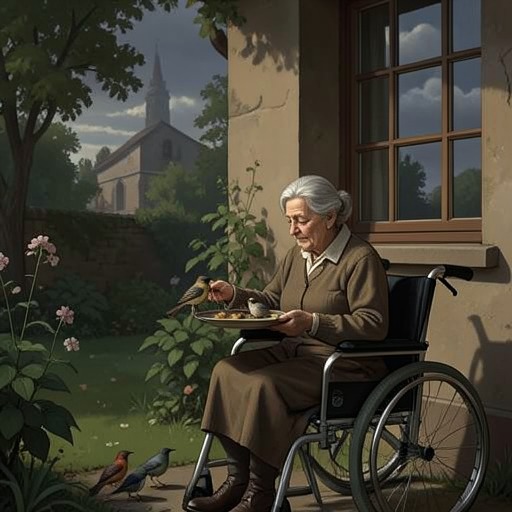
Lavinia’s interest in birds is not a passing quirk but a recurring feature of her daily life and the way she meets other people. At home, she welcomes visitors while birds remain close by; when Hat Bowler describes his visit to the police, he recalls eating toast as a coal tit chattered on his shoulder. He knows the bird as one of Lavinia’s, but has little useful information about Laurence Waverley’s telephone call in the garden. What appears to be an odd domestic detail therefore also becomes a small limit on what Hat can tell the investigators.
Her home life is similarly practical and idiosyncratic. When preparing to leave after learning of Palinurus Maciver Junior’s death, she pulls a cracked Barbour over her T-shirt and changes her wellington boots for stout walking shoes. Later, seeing Laurence Waverley at the house, she turns readily from the family’s crisis to the Green woodpeckers in the garden and remembers leading him to their nest. Her attention to birds gives her a familiar subject and a route back to friendship, even amid grief and police scrutiny.
Loss, Loyalty, and the Maciver Family
Lavinia’s bond with her brother is strained but not extinguished. In the days before Palinurus Maciver Senior’s death, he came to see her in an agitated state, apparently troubled by Kay Kafka and Helen Dunn’s planned trip to the United States. He asked whether Lavinia could look after his household if the need arose, as she had done after his first wife died, but withdrew from explaining what was troubling him. Instead, they talked about their childhood at Moscow House, when the family business had flourished and the future seemed open. Lavinia later worried about his return to their shared memories and made the unusual effort to visit him, wanting to see how things stood at home.
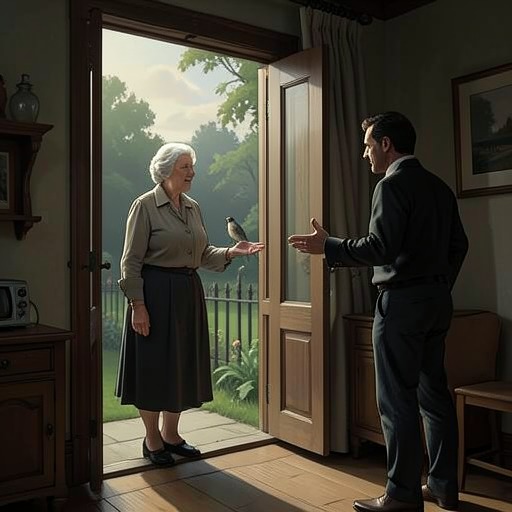
That visit placed her unknowingly at the edge of a crime. Laurence Waverley’s later account reveals that he had just killed Palinurus Maciver Senior and arranged the scene to appear to be a suicide when Lavinia came through the shrubbery. She greeted him by noticing that the Green woodpeckers were still there and invited him to look. Waverley concealed what had happened inside the house and responded to her concerns about her brother as if he were simply an old acquaintance. Lavinia’s openness was innocent; what she offered him was ordinary conversation and a shared interest in birds, but it gave him a human encounter with which to cover his presence and actions.
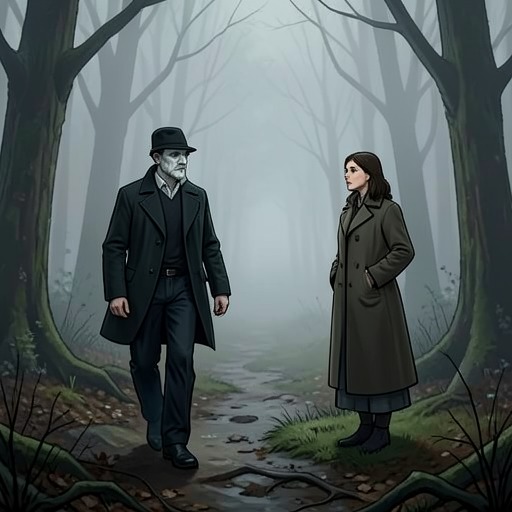
A decade later, Waverley brought Lavinia the news that her nephew, Palinurus Maciver Junior, had died at Moscow House. She had not heard about it through television or telephone; Waverley had come to tell her in person. On learning that Palinurus had killed himself, she fell silent for nearly a minute before asking whether anyone would need her and seeking advice. Waverley urged her to come with him and find out what help was required. The shock briefly made their familiar relationship more direct: Hat observed that they had moved to using one another’s first names. Lavinia’s response is not to presume what role she should play but to ask whether she is needed.
The family connection also appears in Palinurus Maciver Junior’s will. He left the residue of his estate to be divided between Cressida and Lavinia, after making smaller bequests; his wife, Sue-Lynn Maciver, received only fifty pounds. The provision establishes Lavinia’s place among the relatives he chose to benefit, although it does not by itself explain his reasons. In a family marked by estrangement, her name remains part of the final settlement.
Laurence Waverley and the Inquiry
Lavinia and Waverley’s acquaintance began at Moscow House ten years before the inquiry into her nephew’s death. She showed him the Green woodpeckers and led him to their nest in an old beech tree. In retrospect, this innocent episode becomes consequential because it gives the retired VAT inspector a real, long-standing connection to her. Hat speaks of Lavinia with evident enthusiasm and identifies Waverley as her friend, while admitting that he knows little about him beyond that friendship and his visit to report the death.
The investigators revisit the origin of the relationship when they learn that Lavinia met Waverley at Moscow House ten years earlier, while showing him the birds. The fact is not evidence that she participated in wrongdoing; rather, it shows how an authentic friendship can sit beside a concealed history without the friend knowing what it contains. When Peter Pascoe later visits Lavinia with Waverley present, he had initially expected to find her alone, but recognizes that Waverley’s presence may help him approach the matter. Lavinia’s familiarity with both men and her ordinary hospitality are part of the scene, not proof of what she could not have known.
Illness, Care, and Later Life
Waverley’s account of the years after Palinurus Maciver Senior’s death adds another dimension to his connection with Lavinia. After leaving Mid-Yorkshire, he was shot in the leg during an altercation. While recovering, he returned to the area for a convalescent holiday and renewed his acquaintance with her, despite acknowledging that the visit was against the rules of his agency. By then, Lavinia’s multiple sclerosis had noticeably worsened. She continued to struggle on without complaint, and Waverley says he helped her in various ways. He credits those efforts, in part, with her entering a long remission that was still continuing when he told the story.
Lavinia did not tell her family how serious her illness had become. Waverley judges that they were too absorbed in their own concerns to notice more than what could be put down to age. The contrast is significant: while her relatives missed the extent of her condition, Waverley returned, paid attention, and offered assistance. Lavinia’s story therefore links eccentric independence with the need for care, without reducing her to either her illness or her family’s neglect. The bird-watcher who asks whether she is needed is also someone who has spent years quietly enduring a changing condition, and whose chosen attachments continue to shape the life around her.